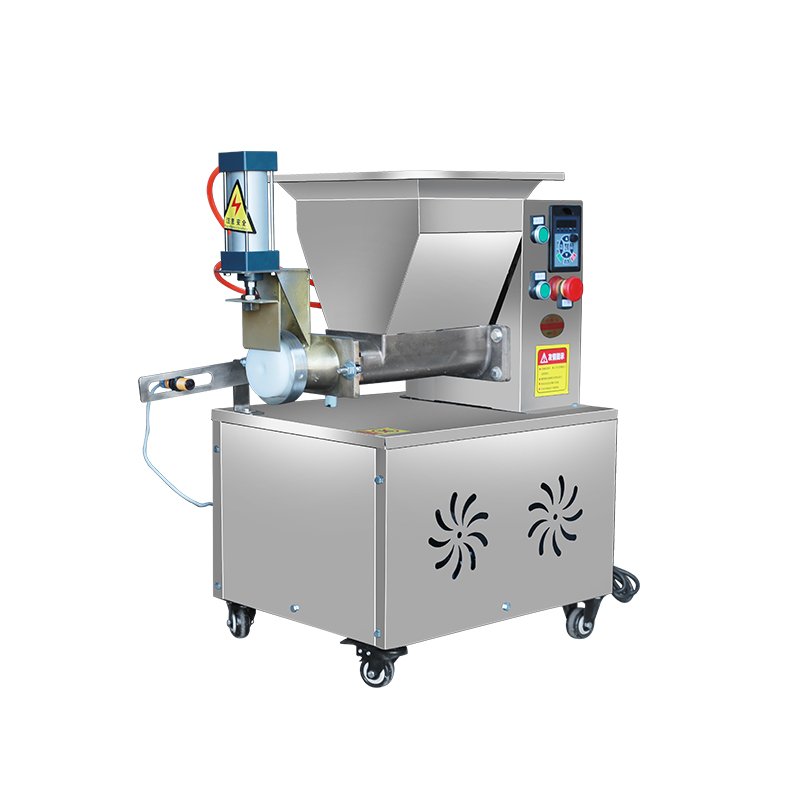
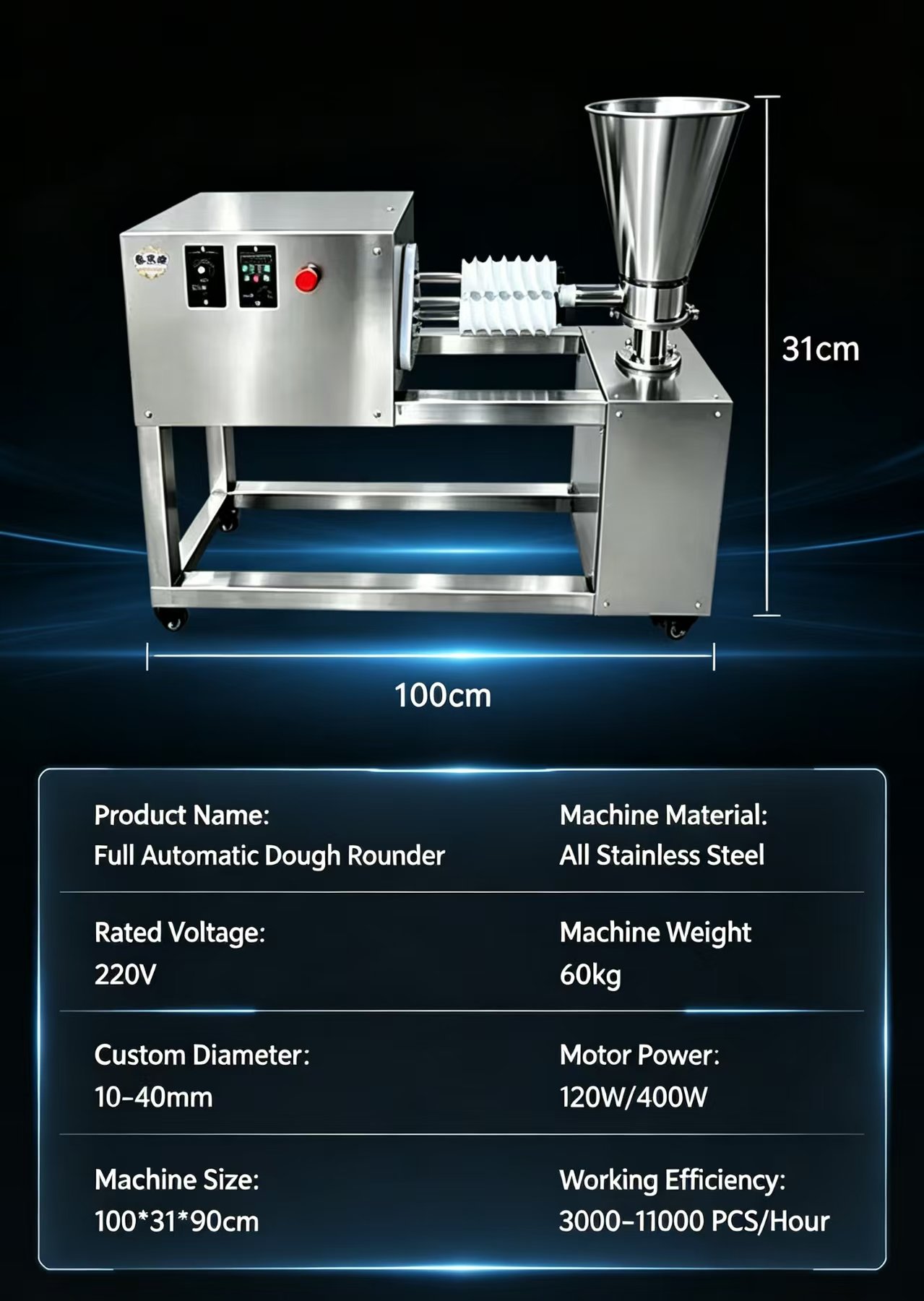
Commercial Dough Splitting and Quantifying Machine vs Fully Automatic Round Machine: Comparison Guide for Purchase Selection
| Dimension | Commercial Automatic Dough Divider & Portioning Machine 1g-500g | Automatic Ball Shaping Machine | Analysis |
|---|---|---|---|
| Hourly capacity | 最大150千克/小时 | 1100-3000粒/小时 | The dividing machine is based on weight and is suitable for large quantities of pasta. The round rolling machine is based on the number of grains and is suitable for spherical food. Need to choose according to the product form. |
| Rated voltage | 220V | 220V | Both use standard 220V power supply, without industrial voltage transformation, suitable for ordinary commercial kitchen. |
| Control system | 数控变频,数字面板 | 智能调速面板 | The slitting machine can adjust the feeding speed, cutting force and target weight; the rounding machine only adjust the rounding speed, with different functions. |
| Net weight | 40-80kg | 60kg | Both are compact equipment with universal wheels at the bottom, which is easy to move and suitable for workshops with limited space. |
| After-sales service | 一年保修 | 质保一年,终身技术支持 | The round rolling machine clearly provides lifelong technical support, the dividing machine is a one-year warranty, and the long-term service is slightly different. |
| Applicable products | 包子、馒头、饺子、月饼、披萨面团;豆沙、芋泥等软馅料 | 糯米团、麻球、芝麻丸、肉丸、鱼丸等球状食品 | The dividing machine focuses on quantitative division, while the round rolling machine focuses on spherical forming, with complementary functions rather than substitution. |
Introduction
In the fields of pastry and spherical food processing, buyers often face a choice between two types of equipment:Commercial fully automatic dough divider and depositor(hereinafter referred to as the “splitting machine”) andFully automatic rounding machine(hereinafter referred to as the “rounding machine”). Although both belong to the category of food-forming equipment, they differ significantly in terms of functional positioning, application scenarios, and technical specifications. Based on objective data, this article conducts a comparative analysis across dimensions such as application scenarios, technical specifications, and selection recommendations to help you make informed purchasing decisions.
Differences in application scenarios
Dividing machine: precise portioning, shaping in the front-end stage of dough processing.
The core function of the dividing machine is to accurately divide large pieces of dough or soft stuffing into uniform agents according to a set weight (1g-500g), which is suitable for scenes requiring subsequent wrapping or molding such as steamed buns, steamed buns, dumplings, moon cakes, pizzas, etc. Its double twisted dragon feeding system protects gluten, which is especially suitable for the division of high elastic dough such as dumpling wrappers and ramen noodles, as well as soft fillings such as bean paste filling and taro paste filling. Typical users include breakfast shops, dumpling processing workshops, mooncake factories, and small food processing plants.
Balling machine: spherical shaping, dedicated for the final balling stage.
The round rolling machine focuses on making the divided raw materials into round balls with an adjustable diameter of 10-40mm. It is suitable for spherical foods such as glutinous rice balls, hemp balls, sesame balls, meatballs, fish balls, etc. Its spiral round structure ensures that the finished product is round and even, and is suitable for health pill processing workshops, quick-frozen food factories, glutinous rice products factories and small catering start-up shops. Round machine does not change the weight of raw materials, only to complete the molding process.
Technical Comparison
The following is an objective comparison of the common parameters of the two:
| Comparison dimension | Splitting machine | Rounder machine |
|---|---|---|
| Hourly capacity | Up to 150 kg/hour (approximately 9,000 servings) | 1,100–3,000 grains/hour |
| Rated voltage | 220V | 220V |
| Control system | CNC variable frequency, digital panel | Smart speed control panel |
| Net weight | 40-80kg | 60kg |
| After-sales service | One-year warranty | One-year warranty, lifetime technical support. |
| Applicable Products | Steamed buns, steamed buns, dumplings, moon cakes, pizza dough; soft fillings such as bean paste and taro paste | Glutinous rice balls, sesame balls, meatballs, fish balls and other spherical food |
Selection recommendations
Select according to the production process.
- If you need to divide large pieces of dough or fillings by weight,Moreover, since subsequent processes such as wrapping, rolling, or shaping are required, a divider is the preferred choice. Its wide range of 1g-500g and deviation within 2g can meet the multi-specification requirements from fine pastry fillings to pizza dough pieces.
- If you already have a dividing machine, or if the raw material is already in strip or block form, you only need to round and shape it.A rounding machine is more suitable. Its 10-40mm diameter adjustment and more than 99% yield, specializing in the uniform appearance of spherical food.
According to capacity and return on investment
- The splitter has a maximum of 150kg per hour, which is suitable for mass production of pastry agents. It can replace 3-5 human workers and return to the original cost in 2-3 months.
- Round machine 1100-3000 grains per hour, suitable for spherical food line, can also replace 3-5 manual round workers, the payback period is similar.
Based on the characteristics of the raw materials
- The double-stranded dragon feeding of the splitter is friendly to high elastic dough and soft fillings, and does not damage the gluten and filling fineness.
- The anti-sticking spiral mold of the round rolling machine can demold sticky raw materials such as glutinous rice and taro mud smoothly, but it should be noted that the raw materials must have certain plasticity, and fillings that are too soft may not be applicable.
Recommended combination usage
For a comprehensive food factory that produces steamed buns, dumplings and glutinous rice balls at the same time, a dividing machine can be used to complete quantitative division first, and then spherical forming can be carried out by a round rolling machine to form a semi-automatic production line and improve the overall efficiency.